The method

You have to perceive before you can conceive

Perceptual Learning helps teachers see how students understand mathematics, so instruction can respond to the thinking behind the answer.

UNDERSTANDING STARTS WITH PERCEPTION

Digits are the alphabet for mathematics.

The information did not change. What changed was your perception of it.


Mathematics works the same way. Students can see the same symbols, numbers, and procedures while perceiving very different relationships between them.


Perceptual Learning begins by uncovering what the student actually sees, because what they perceive shapes what they are able to understand.


The Difference

Two ways to teach the same lesson

Two teachers can address the same mathematics while beginning from very different places. Traditional instruction tends to begin with what needs to be taught. PerceptualLearning™ begins with what students currently perceive and understand.

Where the lesson comes from

traditional

The lesson determines instruction

Content first

Teach, practice, assess

Same lesson for the class

Pacing determines movement

Correct answers reveal success

Mistakes are corrected

PerceptualLearning™

Student need determines the lesson

Understanding first

Assess, perceive need, construct lesson, assess again

Make the lesson fit the student

Formative evidence informs movement

Student thinking reveals understanding

Mistakes are analyzed and used instructionally

What mathematics is treated as

Mathematics as computation

Vocabulary supports the lesson

Memorization

Rules

Isolated skills

Learning today's topic

Fragments

Mathematics as language

Lexicon is a portal to the lesson

Meaning

Relationships

Connected structures

Connecting past, present, and future mathematics

Mosaic

What happens in the room

How do I do this?

Teacher demonstrates

Student imitates

Procedures introduce ideas

Strategy may follow procedure

Practice creates mastery

Simplify by reducing difficulty

What does this mean?

Teacher facilitates discovery

Student perceives, reasons, and explains

Percepts develop concepts before procedures dominate

Strategy precedes tactics

Understanding plus purposeful repetition creates mastery

Simplify by revealing structure

The difference is not the mathematics being taught. It is the information the teacher uses to decide what happens next.

The progression

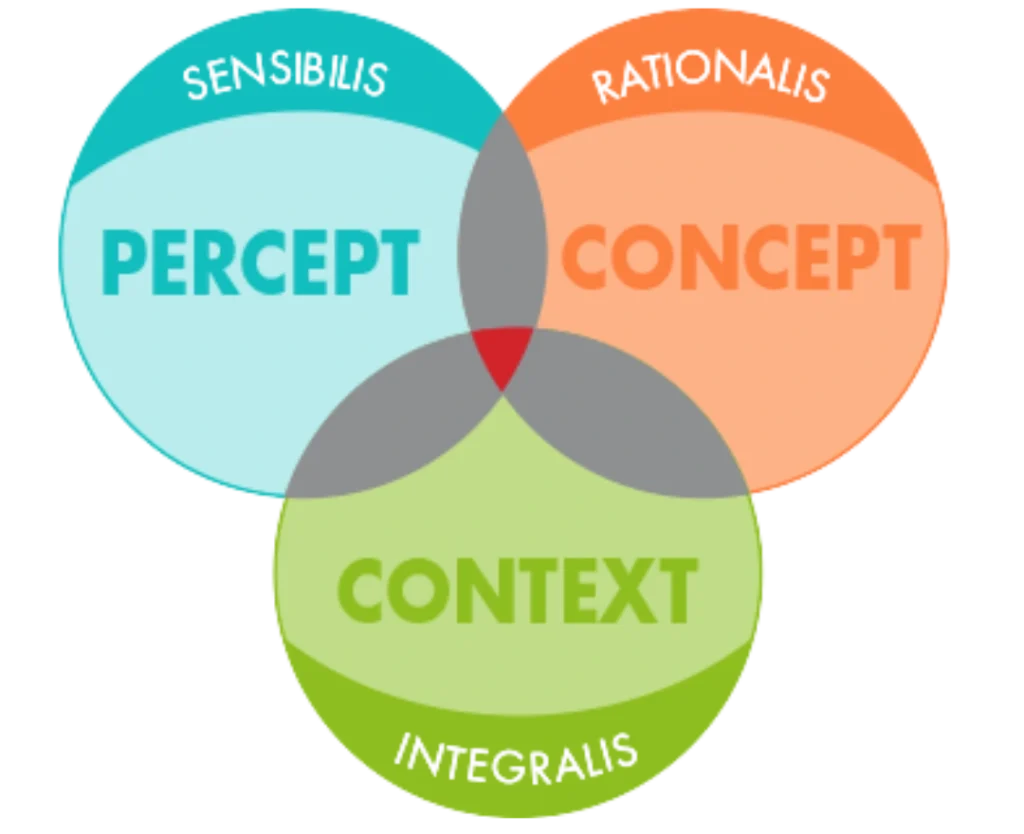
Percept - Concept - Context

PerceptualLearning™ gives teachers a framework for examining how understanding develops: what students see and hear so they can perceive. Then understanding takes place.

PERCEPT | SENSIBILIS - What does the student see/hear?

Lexicon

Can the student recognize the language of math?

Perception

What patterns, quantities, distinctions, and relationships do they notice?

Structure

Can they see how the parts fit together?

CONCEPT | RATIONALIS - What does the student understand?

Continuity

How does new learning connect to what they already understand?

Conception

What mental model has the student formed?

Connection

Can they connect concepts, representations, procedures, and prior knowledge?

CONTEXT | INTEGRALIS - Can the student use it?

Strategy

Can they determine what kind of approach the situation requires?

Tactics

Can they choose and use a method intentionally?

Transfer

Can they apply their understanding when the problem or usage changes?

A student’s answer tells us what happened. This structure helps teachers investigate the understanding.

Emerging research

Independent research is consistent with the premise

Research in mathematics education and the learning sciences has repeatedly demonstrated the importance of recognizing structure, connecting representations, activating prior knowledge, and transferring understanding into new situations.

It also points to an important distinction: performance and understanding are not always the same thing.

A student may successfully reproduce a procedure without understanding why it works, when it applies, or how it connects to other mathematical ideas.

PerceptualLearning™ gives teachers a way to look beneath that immediate performance and investigate the understanding producing it.

The goal is not simply to help students perform today’s task. It is to develop understanding they can use tomorrow.

RELATED RESEARCH

perceptual-learning-london-ky-23

What transfers

Students begin using the thinking into other areas

When students learn to recognize structure, make connections, question assumptions, and choose strategies intentionally, those habits do not have to remain inside one mathematics lesson.

They can carry into unfamiliar problems, future courses, and even other subjects.

That is transfer: understanding that remains useful when the situation changes.

Get started

Let's talk about
where your students are

Understanding starts with where students are now: what they perceive, what they understand, and where misconceptions and/or missed conceptions are forming.

Let’s start there.