Every figure on this page comes from schools and students PerceptualLearning™ has directly impacted. Percentiles are national. Rankings are Kentucky.
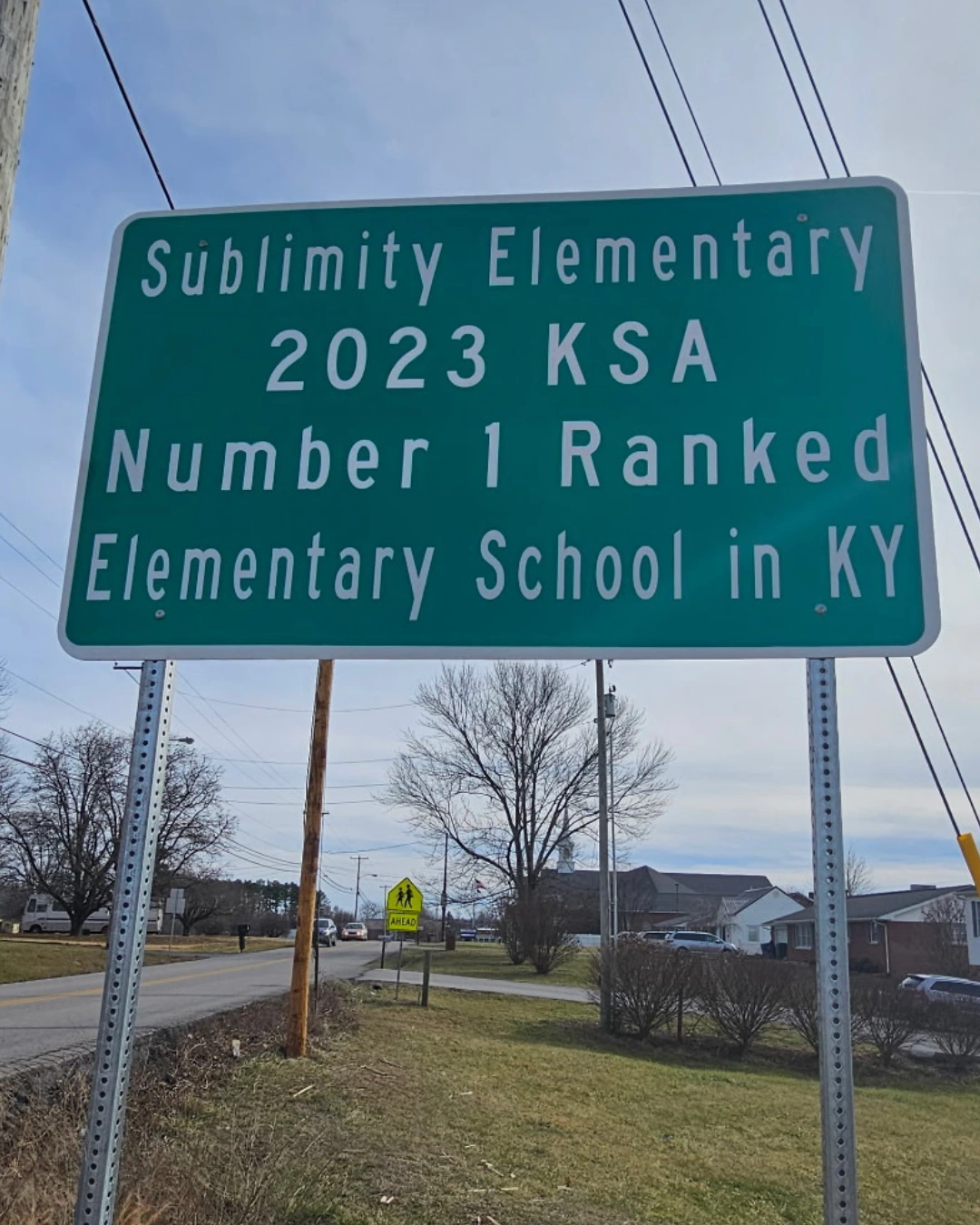
Sublimity Elementary ranked 286th of 713 in Kentucky elementary schools. By 2023 it ranked 1st of 700, moving from the 59.9 percentile to the 99.3 percentile.
The school serves a 67.5 percent free and reduced lunch population. That makes growth of this size harder to achieve, not easier, and it is the reason this result matters more than a ranking from a well resourced district.
Barbourville and Estill County have no published figures attached to them here. What exists for those districts are letters, and they are below.
These students were using the method before their first ACT. Grade levels are shown so the growth can be read against them. These are percentile ranks, not percent proficient.
Will W.
7th to 8th grade
91st to 99th percentile From the top ten percent nationally to the top one percent.
Dane R.
7th to 8th grade
84th to 98th percentile Fourteen points across a single grade level.
Ifrah H.
7th to 8th grade
91st to 97th percentile Already in the top ten percent, and still moved.
Lane G.
7th to 12th grade
79th to 99th percentile The widest span on the sheet, ending in the top one percent.
Grant G.
9th to 11th grade
74th to 98th percentile Top quarter to top two percent, freshman year to junior year.
Aleena J.
9th to 11th grade
70th to 93rd percentile Twenty three points, into the top ten percent.
Zach N.
10th to 12th grade
65th to 88th percentile The furthest back of anyone here, finishing ahead of seven of eight students nationally.
Sam B.
11th to 12th grade
74th to 96th percentile Twenty two points across one grade level, junior to senior year.
These are unedited letters written on Don’s behalf. Full text is available on each.
I am writing this letter as the Superintendent of Estill County Schools in Kentucky to express my strong support for PerceptualLearning and its innovative approach to education. Over the course of my career in Kentucky’s public schools, I have had the privilege of witnessing and implementing this methodology firsthand, and I can attest to its profound impact on student success.
My experience with PerceptualLearning began several years ago when I was a high school math teacher. At that time, I collaborated closely with Mr. White, who was also a high school teacher, to explore and apply its principles in our classrooms. Back then, PerceptualLearning was not as polished as a fully developed philosophy and methodology, but we quickly realized its effectiveness. Our students consistently performed at higher levels than their peers, demonstrating deeper mastery of mathematical concepts and improved problem-solving abilities. This early collaboration laid the foundation for my enduring belief in its potential.
As I advanced to roles as a school and district leader here in Kentucky, I implemented PerceptualLearning more broadly across our schools. The results have been transformative, with measurable improvements in student academic outcomes across all disciplines, including mathematics, humanities, arts, and sciences. By emphasizing perceptual learning, students not only master core concepts and standards but also expand their own learning through inductive and deductive reasoning. This approach promotes productive struggle, builds confidence, accelerates learning by meeting students where they are and pushing them to greater heights. It cultivates a deep understanding, enhances critical thinking, and drives analytical skills, going far beyond surface learning to help students make cognitive connections that might otherwise be missed.
In our district, we have seen significant gains in test scores and overall student performance, reflecting the efficacy of PerceptualLearning in fostering depth of knowledge and achievement. This innovative method has the potential to revolutionize teaching and learning not just in Kentucky, but nationwide, empowering educators to unlock every student’s full potential.
I wholeheartedly endorse PerceptualLearning and recommend its adoption in schools everywhere. Please feel free to contact me if you require any additional information.
Charlie Brock
Superintendent | Estill County Schools
As a public school district superintendent, I witnessed the transformative power of PerceptualLearning in our classrooms. This innovative approach not only boosts student learning, depth of knowledge, and achievement, but also enhances critical thinking across various disciplines, including mathematics, humanities, arts, and sciences. By cultivating a deep understanding and driving analytical and problem-solving skills, PerceptualLearning goes far beyond surface learning and help to make cognitive connections that may otherwise be missed. Our district saw significant measurable improvements in test scores and overall student performance, reflecting its effectiveness. PerceptualLearning has the potential to revolutionize teaching and learning nationwide.
Doug Bennett
Former Laurel County Superintendent | College Professor University of the Cumberlands.
My freshman year in high school, I discovered that there are two perspectives of learning. One is very superficial and the other is in-depth. I was made to realize that I was on the wrong track.
I had A’s in all my math classes in middle school. How dare this freshman algebra teacher, who taught under the brand of PerceptualLearning, insist on me to change my M.O. (method of operation).
I always did “rote” well. That was memorizing the tricks and schemes to replace strategic thinking and memorizing the keys on my calculator to facilitate obtaining answers. I knew how to make A’s and he had the audacity to want me to change…to comprehend what was going on. My resentfulness finally went away when I experienced the satisfaction of understanding. This knowledge became the foundation for my philosophy of education. “Why” is much better than “how”!
After high school, I went to college majoring in Elementary Education with an English Communications emphasis, received my master’s as a Literacy Specialist, and obtained my Rank I in Middle Grades Mathematics Education and Elementary Math Specialist. One of the first jobs I had was teaching elementary school math…of all things, I was a math teacher. It just happened that my freshman algebra I teacher worked for my school district as a consultant. So, I asked for and received his coaching. Afterall, I realized that PerceptualLearning was becoming part of my culture.
With all of that said and done, please let this letter validate this methodology and philosophy called PerceptualLearning.
Meredith Chandler
Instructional Coach | Estill County Schools
In this day and age, we all are looking for ways to streamline and improve instruction. Society’s focus on “leaving no child behind” has pressured many teachers into drilling test-taking strategies at the expense of mastery learning. That kind of teaching is not what we planned for our careers when we entered the profession. In contrast, this paradigm describes a methodology that builds conceptual understanding while developing reasoning skills.
One ninety-minute classroom observation in January 2007 marked a turning point in my teaching philosophy. I had just been hired as an Instructional Supervisor in August 2006, so I was eager to compare our district’s student performance to that of comparable districts. I noticed a neighboring district had comparable math scores in the eighth grade, but their ninth graders had consistently improved. This trend was an anomaly that made me curious. When I found out a ninth grade math teacher, Don White, was the husband of one of our own teachers, I solicited an opportunity to visit his classroom. That visit changed my view of teaching forever. After twenty-two years in education, I experienced an Algebra I class as all math classes should be taught.
After watching him guide a classroom of average freshmen through a lesson on quadratic functions, I was hooked! His Algebra I students skillfully handled problems and questions that would challenge many of our Algebra II students — and his students were in the middle of their Algebra I course! When I observed his teaching, I noticed how he insisted on clarity of definition; comparing and contrasting; connections and generalization. This in turn facilitates connected and in-depth understanding.
True to his philosophy that less is more, the homework assignment from the previous day was only one problem, but the mathematical knowledge needed to solve the assignment was staggering. The students could not wait to share their strategies for solving the problem. Their pride and confidence was affirming and empowering. The classroom was as much an immersion in the language of mathematics as any foreign language immersion program. I was enthralled with the experience. I could not wait to visit again, and I wanted my teachers to share in the experience as well.
I finish on a personal note. I had the privilege of having Don work with my son in enrichment sessions for several years. As a result, he developed critical thinking and reasoning strategies that made him a better student in all his classes. Thus, I have witnessed the impact of PerceptualLearning from both a personal and a professional point of view. It works!
Monica Smith
Director of Secondary Education | Laurel County Schools
I am a non-traditional student, now 44 years old. When I began preparing for the Praxis Exams to enter the University of the Cumberlands MAT program, I was terrified of the math requirement. For as long as I can remember, math had been my greatest academic struggle. It was the subject that left me in tears, the one that fueled a voice of self-doubt telling me I wasn’t capable enough. I had resigned myself to believing English was my only true strength. They say that you can’t teach an old dog new tricks, but they evidently have not found the PerceptualLearning methodology. While the methodology is not a “trick,” it can certainly rewire someone’s brain after years of being taught math from rote memorization and “tricks” to get the “right answer.” I had taken the math entrance Praxis several times, discouraged and in tears, knowing this was the one test that separated me from fulfilling a calling on my life to become a teacher or never being able to teach at all.
Everything changed when I encountered PerceptualLearning. This approach did not rely on rote memorization or test-taking tricks. Instead, it emphasized conceptual understanding, pattern recognition, and strategy. For the first time, I was able to see why math worked the way it did. That shift transformed both my performance and my confidence. Over time, they not only improved but eventually surpassed my nearly perfect reading and writing scores—something I never imagined possible.
The impact of PerceptualLearning extended far beyond math. By focusing on reasoning, generalization, and higher-order thinking, I gained skills that helped me succeed on additional certifications, which I passed on the first attempt. The program’s emphasis on true understanding over memorization reshaped how I learn, how I teach, and how I view myself as a learner. My family, who knew my lifelong struggles, were amazed by the transformation. My students now even seek me out for help in math—an outcome that once would have seemed unthinkable.
PerceptualLearning is more than a test-preparation tool. It is a methodology that builds confidence, resilience, and intellectual independence. It fosters lasting growth by teaching students how to think conceptually and strategically, equipping them with skills that extend beyond a single subject or exam. For me, it was the difference between carrying a lifelong insecurity and stepping into a new identity as both a capable learner and a successful educator. I will be forever indebted to this way of learning.
Tara Prewitt
High School Teacher | Corbin Independent Schools
PerceptualLearning™ revolutionized the way I plan and deliver math instruction. Teaching a traditional linear path left me feeling exhausted, unproductive, and inefficient. Using what formative assessments reveal, I know the focus of my lessons to meet the needs of my students. Efficiency and proficiency prevail. The results speak for themselves.
Trey Chesnut
Middle School Math Teacher | Barbourville Independent Schools
My Name is Addison Pitman. During my 8th grade school year, I began studying math under a teaching style called PerceptualLearning. The previous summer I took the ACT, to get a baseline of where I was, and received a composite score of 20 with a math score of 20. While studying under the PerceptualLearning brand, I learned conceptual thoughts… to avoid rote as much as I could; and not use schemes/tricks to arrive at answers. I also learned how to generalize and how to use microcosms/macrocosms in the thinking process. That helped me define strategic and tactical thinking skills. I learned math in a way that had a positive influence on my entire academic experience. I became a better thinker.
In June, before my 9th grade school year, I took the ACT for a second time. I received a math score of 30 with a composite of 25, and I was not in high school yet. Studying under PerceptualLearning created a growth of 10 points in math in exactly one year. Because of my concept-based learning skills, my science and reading scores also increased.
I have just recently received my ACT scores from June 2025 ACT. My composite was 29 and my math score was a 35 with 36 being the maximum. Those results came from working one hour per week for less than two years with PerceptualLearning.
My PerceptualLearning experience has created rapid growth in my ability to reason and do problem solving. My self-image and confidence have really improved too.
I think PerceptualLearning provides a one-of-a-kind method for efficient and in-depth learning. This is not just a “math thing” even though a ton of math is perceptually learned.
Please let this communication validate this teaching and learning style that’s called PerceptualLearning. I know about it. I am a product of its culture. I feel very prepared to go into my last three years of high school.
Addison Pitman
Student — ACT gains
My name is Dane Root. During my 6th grade school year, I did academic enrichment under a brand called PerceptualLearning to prepare me for the academic team competition. My mom said that this tutorage and enrichment would probably develop my thinking skill to its fullest. Wow! She was “right on!”
PerceptualLearning started a learning experience that taught me organization, focus, and how to put thought together through the pathway of percepts. The concepts that I developed made me realize that rote learning was superficial
In retrospect, the way this learning methodology used formative assessments to cause productive struggle was efficient and it created in-depth thinking skills. I was able to see and hear better than I had seen and heard before.
In the 7th grade I was invited to participate in the Duke University Talent Identification Program. I had taken the ACT for the first time and scored a 26 in math. The Duke TIP recognized me at an awards program at Western Kentucky University.
I continued to work one hour per week with PerceptualLearning. In July 2020, the summer after my 8th grade year, I took the ACT again. I scored a 33 in math. In April, my 9th grade year, I scored a 35 in the math section of the ACT. I finally achieved a perfect score of 36 in math at the beginning of my 10th grade year. I was able to maintain the 36 in math while attaining a 36 in science and english on my next test. My highest reading score was 33.
PerceptualLearning helped me to be successful in all areas of summative assessments. From my 7th grade through my high school I was chosen to compete in the University of the Cumberland annual math contest. During that time, I earned first place honors in algebra, precalculus, and calculus. I was also a Governor’s Scholar in 2023 and a National Merit Finalist in 2024.
I feel very confident as I start my second year in college, majoring in engineering. I was on the President’s List in the fall of 2024 and the spring of 2025. My GPA is 4.0. PerceptualLearning helped me immensely on both my academic and learning trail.
Dane Root
Student | Duke TIP, National Merit Finalist
I started school in a one room school at Twila, Ky. in 1955. It was at the head of the holler in Wallins Creek, an area of Harlan County. At Christmas time, our family moved to the city of Harlan to cut my Dad’s drive time in half. He worked in a mine at Cranks, Ky. When I got to Harlan City Schools, as a transfer I was put in the slowest class. Mrs. Williams often held speed contests of her class to see who could put the correct answer on the board first for arithmetic problems. I was unhappy to be put in the slow class and was determined to work my way up. Finally, in the fourth grade, I was promoted to the best group, the Blue Birds! During my time at Harlan, we were welcomed to middle school with an awesome lineup of teachers, English, History, Social Studies, Science and Math in the Eighth Grade. When we got to the High School, I first encountered Don White as my Algebra I teacher.
Algebra I was the most enjoyable class I had ever taken, up until that time. We learned to speak math in a very precise context. We were admonished to understand each concept totally, before we moved to the next. Every word out of Mr. White’s mouth was music to my ears. The more I learned about Algebra, the more I wanted to learn. We went to Math Contests around the state, two Algebra Is, two Geometry students, two Algebra IIs and two Trig students. Seems like we had 5-6 finish in the top ten of every contest. One contest in Louisville, Algebra I students were given 100 questions, 4 points for each right answer, -1 for each wrong answer. I got 99 right, and 1 wrong. A girl from Eastern HS only answered 99 and got them all right. She beat me 396 to 395. But I was good with that. From a one room school to 2nd in the Stater in nine years was fine with me!
Without a doubt, Don White’s teaching helped not only me, but the all the students and all the staff at Harlan High. We learned to be precise in our language, open to new concepts, and to understand the basics before moving to the next tier. Our class of 88 included a Kentucky Poet Laureate, the Head of the US Wildlife Service, President of Ducks Unlimited, a State Representative, who lead the overhaul of the Kentucky Public School System, and many other successful citizens.
There have been a couple of times in my life when I recognized life changing events about to happen and have attempted to change them. One was the day, between my Junior and Senior years that I heard Don White was leaving teaching. I immediately sought Don out and implored him not to leave. I selfishly knew that I was losing the best teacher I had ever had, but I also knew that he loved teaching. It was his daily quest; to be the best teacher and to teach us to be the best students we could be. He left anyway. But he came back. Though all his endeavors, the end result is that all he ever really wanted or needed to do was teach. Mr. White, “I told you so!” Your teaching methods are impeccable, I wish all kids could be exposed to your methodology.
Side note: The only thing I have taught is youth basketball. I started a Junior Pro league in Harlan that had between 100-120 kids from K-6 grades. Ran it for 10 years. It morphed into AAU and travel ball. I found myself creating a language that I insisted everyone hear and speak, I insisted that everyone learn the basics before moving to harder concepts. From those ten years of league and travel, I’ve tutored a Kentucky Mr. Basketball, Kentucky Hall of Famer, Georgetown College Hall of Famer, Tennessee Wesleyan Hall of Famer, Eastern Mennonite College Hall of Famer, 4 All Staters, and numerous AAU All Staters. I learned from the best!
Jerry K. Blanton
Former high school student, class of ’88 | Harlan County
My experience and focused implementation of the PerceptualLearning methodology began during my junior year of high school. Initially, I decided to learn under this methodology to increase my score on the mathematics section of the ACT. However, after a year and a half of math enrichment under this approach, I noticed that I had gained much more than just a higher score on one section of a standardized exam. While this approach succeeded in increasing my ACT score in mathematics in a short time, it also provided me with much-needed confidence in math. Among the many benefits of this methodology, the one I value most is a clearer understanding of the purpose and nature of not only mathematics, but of learning.
After I began learning under this methodology, my scores on the mathematics section of the ACT were not the only subject that showed substantial growth. My scores on the English sections showed greater improvement than my mathematics score. While I increased my mathematics score to a desirable level, the PerceptualLearning approach also elevated my thinking in other disciplines and, to my surprise, helped me score much higher in multiple content areas. I am confident the simultaneous growth of my English and mathematics scores was the result of my development of strong logic and reasoning ability from a conceptual approach to learning. The PerceptualLearning approach has shaped the way I analyze and process information, notice patterns and trends, and structure/understand arguments (and logical proofs). Alongside the improvement in my ACT scores, I also saw a notable improvement in my academic performance in my classes during my last two years of high school. While I maintained good academic performance previously, after I began learning under the PerceptualLearning methodology, I noticed that I started engaging in my classes on a higher intellectual level, understood the concepts taught in class quicker and easier, and obtained much higher scores on exams. By the end of high school, I had become a more mature, skilled, and confident student.
The PerceptualLeraning methodology avoids rote memorization, gimmicky or derivative techniques, and goes beyond merely seeking the correct answer. Instead, the PerceptualLearning approach focuses on developing deep and lasting understanding by emphasizing mathematical perceptual principles. Similarly, using this approach ensured that I developed a thorough understanding of foundational mathematical principles and the reasoning behind them. In doing so, the PerceputalLearning methodology made me more mathematically articulate and strengthened my logical thinking and reasoning. I believe that this improved articulation and analytical thinking will, for many students such as myself, improve the way they read, write, create art, and learn across all disciplines. Thus, the PerceptualLearning methodology is more than learning how to become a better mathematician or student. Rather, this methodology uses mathematics as a tool to cultivate logical thinking, comprehensive understanding, and critical thinking skills in each student. This approach prompts students to never be satisfied with merely knowing how to find an answer to a particular question. Instead, this approach teaches students to engage with learning in a deeper fashion. That is, in the process of searching for the correct answer, the student should also seek to demonstrate or gain understanding of the reasoning behind the method that leads to the solution and how and why the mathematical principles that were utilized connect, in a holistic manner, to other mathematical concepts and principles. This process makes reliance on rote memorization relatively unnecessary and makes learning mathematics more enjoyable and less burdensome for the student.
As my experience with PerceptualLearning taught me, math (like English, Latin, music, and the visual arts) is also a language. This mathematical language may look different from traditional languages, but its nature and function are the same. While these languages may do so in different ways, the English language and the language of mathematics are both tools that people utilize to convey truth about the world. At its core, mathematics is a way of speaking and interacting about the world and how it operates. Likewise, the English language and mathematics both require and are the product of logical reasoning. The PerceptualLearing methodology prompts students to think of math as a language. That is, this approach teaches students to understand and articulate how mathematics can be used to explain and discover certain truths and logical outcomes. Just as one cannot be fluent or an effective communicator in English without first knowing the foundational principles of the language (grammar, syntax, style, diction, etc.), one cannot be fluent in mathematics if he/she does not know the corollary, foundational principles in mathematics. PerceptualLearning helped me to become more fluent in the language of mathematics, while also greatly bolstering my conceptual and critical thinking skills.
The PerceptualLearning methodology is not only effective in developing excellence in mathematics, but it also provides intellectual freedom to the student. By removing dependence upon mathematical tricks or rote memorization, the student is free to answer/ask questions without fear or anxiety. This approach provides the student with the articulation and solid mathematical/logical foundation to engage in the learning process, to convey complex mathematical concepts in understandable terms, and to search for answers in a creative, conceptual, and holistic approach. It is my experience that if a student is diligent and approaches learning under this methodology with an open and ready mind, he or she will cultivate a desire for learning and experience joy in the process. The PerceptualLearning methodology is one I am convinced is effective and beneficial. This approach has greatly improved my reasoning, and I am thankful to have increased the efficiency, depth, and speed of my learning through PerceptualLearning.
Sam Bennett
College-bound senior, Dr. Doug Bennett’s son
Research in formative assessment, conceptual understanding, student thinking, and transfer supports many of the instructional principles at the heart of Perceptual Learning.
Tell us what you are seeing in your classrooms. If Perceptual Learning is the right answer, we will show you what that looks like in your building. If it is not, we will say so.